From Their Horses Came Their Cavalry
How the Winged Hussars and the King of Poland Helped Save Vienna and Christian Europe From the Ottoman Empire in 1683.
Throughout history, it has usually the rider who is remembered - while the horse being ridden is forgotten. Yet in Poland, this was reversed.
The strength of the Polish cavalry did not begin in the saddle. It began in the breeding of the horse. Long before battles were fought, before cavalry formations moved across open ground, there existed a deliberate and sustained effort to produce animals capable of carrying men into war with speed, endurance, and unwavering reliability.
The Polish cavalry was mounted on some of the finest horses in the world. These were not incidental mounts gathered in times of need, but the result of generations of careful breeding with the infusion of horses from the Levant, captured during battles with the Ottomans as well importing mares and stallions from the deserts of the East. They were broadly referred to as “Oriental” horses, and what we now most readily recognize in the Arabian. These animals were prized for qualities that could not be manufactured: intelligence, stamina, responsiveness, and an innate willingness to work in close partnership with man.
From this foundation emerged a distinct type of cavalry horse — one capable of sustained speed, rapid maneuver, and extraordinary endurance. These horses were bred to carry a rider and respond instantly to subtle cues, to turn, accelerate, and endure under the most demanding conditions.
The creation of a good Polish cavalry horse was not a simple affair. It required time, discipline, and patience. Young horses were not rushed into battle. Ideally, they were used only after reaching full maturity — around seven years of age — when they had been properly trained, experienced, and acclimated to work. Strength and endurance were essential, but of equal importance was temperament. A cavalry horse had to remain composed, responsive, and cooperative in the chaos of combat.
— attributed to Swedish General Arvid Wittenberg
Such observations speak to the extraordinary capabilities of the horses themselves - not merely to the skill of the rider.
Vienna, 1683. The Doorway to Christian Europe.
Nowhere was this more evident than at the Battle of Vienna in 1683.
As the city stood under siege by Ottoman forces advancing into the heart of Europe, the situation had grown critical. Vienna itself was not the true objective—it was the gateway. Beyond it lay the possibility of continued expansion westward into the territories of Christian Europe.
The relief of the city came under the leadership of King John III Sobieski of Poland, who assembled the most formidable cavalry force in Europe. At its core were the Polish cavalry - the Winged Hussars - mounted not on ordinary horses, but on animals bred, selected, and trained for precisely this kind of moment.
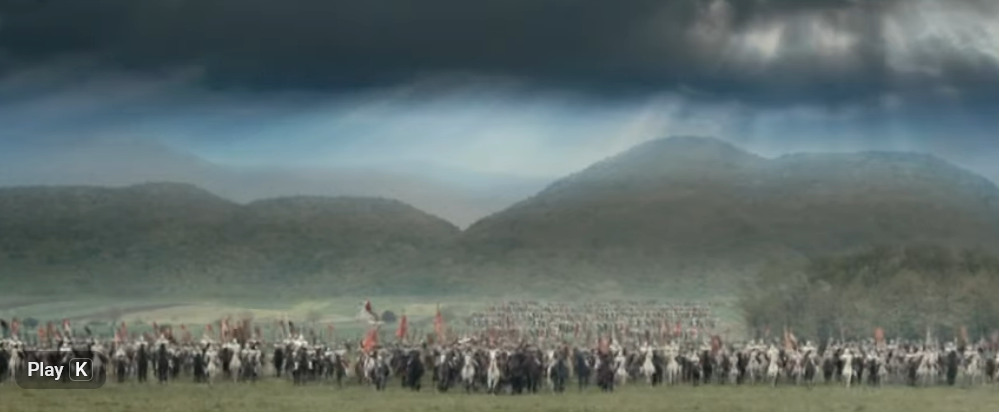
Twenty thousand horses charged in unbreakable lines in what is widely regarded as the largest cavalry charge in recorded history. The charge of the Polish Cavalry in saving Vienna supposedly was Peter Jackson's inspiration in visualizing the Charge of the Rohirrim during the Siege of Gondor in "The Lord of the Rings: The Return of the King."
The Charge of the Winged Hussars:
A modern interpretation of the Polish Winged Hussars and the scale of the cavalry charge at Vienna as seen in the music video, Sabaton - Winged Hussars, featuring scenes from the film, "The Day of the Siege: September Eleven 1683."
The Ottoman lines broke, and the siege was lifted. But Vienna itself was not the true measure of the moment.
Under the leadership of Sobieski, the relief of Vienna marked a decisive turning point in the westward expansion of the Ottoman Empire. Beyond the walls of that city lay the possibility of continued advance into the heart of Europe.
The charge that descended that day did more than relieve a siege. It halted a momentum that had carried for generations.
For many, it was understood as more than a military victory. It was seen as the preservation of Christian Europe at a moment of real uncertainty. And at the center of that moment—beyond the banners, beyond the command—were the horses. Bred for endurance, trained for discipline, and capable of sustaining the kind of force that no infantry could outrun, they made possible what followed.
It was not the city alone that was saved, but the course of expansion itself that was checked.
Pulaski as One Thread in a Larger History
Among those shaped by this tradition was Casimir Pulaski, a Polish nobleman and cavalry commander who would later come to be known as the “Father of the American Cavalry.”
Born into a culture where horsemanship and warfare were inseparable, Pulaski was trained within the very system that produced the Polish cavalry’s reputation. His experience was not theoretical—it was lived, developed through years of riding, training, and operating within a tradition where the quality of the horse and the skill of the rider were equally essential.
This was the world from which Pulaski emerged.
Pulaski did not bring something entirely new to America. He brought with him the accumulated knowledge of a cavalry tradition built upon the horse. The principles he applied—mobility, coordination, speed, and decisive action—were made possible by the type of horse he knew and the system from which it came.
He even is said to have brought his own "war horse" with him on the ship that carried him to America. The identity of Pulaski’s personal horse has not been preserved with certainty. No name remains in the historical record. Yet it can be said with confidence that the horse he rode was of the same general type that had carried the Polish cavalry for generations—an animal shaped by the same breeding philosophy, influenced by the same desert-bred ancestry, and trained within the same disciplined system.
In Poland, the horse was not merely equipment. It was a constant companion—present in movement, in camp, and in battle. A cavalryman’s effectiveness depended as much on the quality of this partnership as on his own skill.
When Pulaski rode into the American Revolution, he carried that partnership with him. His influence on the development of American cavalry was not simply a matter of tactics, but of perspective—an understanding that the true strength of cavalry lies not only in the rider, but in the horse beneath him.
Pulaski’s story, then, is not only his own. It is one thread in a much larger history—a history in which the Polish cavalry achieved its reputation through the deliberate creation and preservation of exceptional horses. Horses whose ancestry reached back to the deserts, and whose qualities were refined through generations of careful breeding. To understand this legacy is to recognize that the horse was not secondary to history—it was central to it.
It is within this understanding that the preservation of the Polish Arabian and its related bloodlines takes on its deepest meaning. These are not merely animals of the past. They are living connections to a tradition that shaped nations, carried armies, and altered the course of history itself.